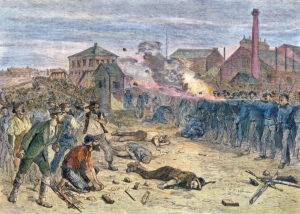
 On July 25 and 26 in 1877, 149 years ago, over 10,000 immigrant laborers on strike clashed with law enforcement officials, including federal troops and state police, during the Battle of the Viaduct.
Also known as the Battle of the Halsted, the Battle of the Viaduct was one of the bloodiest labor uprisings in Chicago history. In 1877, railroad pay cuts triggered the strike that saw meatpacking workers and switchmen walking away from their jobs and marching through immigrant neighborhoods in solidarity. The conflict was part of the larger, nationwide Great Railroad Strike and was a turning point for the future of organized labor.
Eventually, order was restored and workers returned to their jobs. Resulting in an estimated thirty deaths and over one hundred injuries, union workers realized unorganized uprisings could not withstand a unified power such as the state police.
Although the strike was not successful, laborers learned in order to stage an effective strike, organized collective action was essential.
The Battle of the Viaduct united immigrant working class neighborhoods to fight side by side. It showed workers that in order to fight for labor rights, they had to come together regardless of background. The battle also served as a stark reminder to many laborers at the time that the government and military would choose to side with corporate interests.
The battle was the catalyst to future labor uprisings in Chicago including the 1886 Haymarket Affair and the 1894 Pullman Strike. These strikes were more organized demonstrations that led to large labor rights recognition such as International Workers’ Day, also known as May Day, which was directly inspired by the Haymarket Affair.
The labor movement in Chicago played a key role in securing workers’ rights nationwide. Chicago laborers led the charge to reduce 12+ hour shifts to the now typical eight hours. Local labor conditions also inspired Upton Sinclair’s novel, “The Jungle,” which shed light on Chicago’s meatpacking industry conditions. Sinclair’s novel exposed the dangerous working conditions that led to Congress passing the Pure Food and Drug Act and the Meat Inspection Act of 1906, improving safety standards in food production.
Catalyzed by the Battle of the Viaduct, many modern safety standards and labor rights came to fruition through organized labor in Chicago.


