
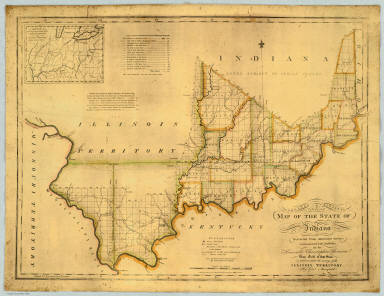
 On Feb. 3, 1809, the 10th United States Congress passed legislation to officially establish the Illinois Territory, carved out from the western portion of the existing Indiana Territory. The decision was made after Congress received several petitions from residents in the area complaining of the difficulty of participating in territorial decision-making given their great distance from the territorial capitol in Corydon, and requesting a greater degree of autonomy. The new Illinois Territory included the boundaries of our modern state, as well as land that now makes up parts of Wisconsin, Michigan, and Minnesota.
The name of the new territory, “Illinois,” predated its establishment by Congress by over a century. In the 17th and early 18th centuries, the land had been under French control as part of the territory of French Canada. Early French explorers coined the word as an adaptation of an Algonquian term, likely the Miami-Illinois “irenweewa,” meaning “ordinary speaker.” France ceded all of its North American territory, including Illinois, to the British at the end of the French and Indian War, and the British in turn lost the land to the new United States government after their loss in the American War of Independence.
Less than a decade after Congress voted to create the territory, Illinois was admitted to the Union as the 21st state on Dec. 3, 1818. It was officially admitted as a free state, though the Illinois Constitution permitted some use of slave labor in certain industries, such as the Shawneetown salt works, until 1865. During the American Civil War, Illinois remained part of the Union and became a major source of troops and supplies for the Union Army. Before the final Union victory, Illinois was the first state to ratify the 13th Amendment ending slavery on Feb. 1, 1865, helping President Lincoln in achieving one of his final and greatest accomplishments.


