
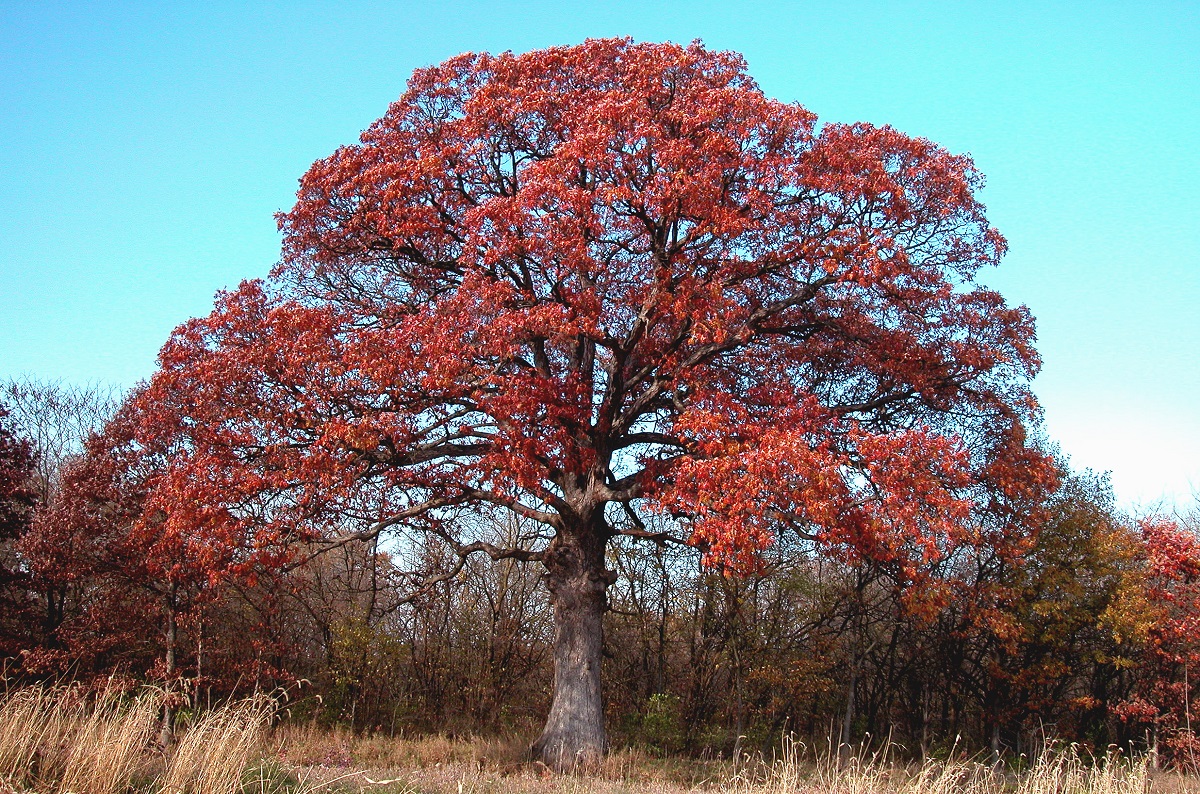
In 1908, Illinois schoolchildren voted for the State Tree. They could select from native oak, maple and elm. The native oak was chosen as the State Tree. There are many kinds of oak in Illinois, so a special vote was taken in 1973 to pick the type of oak for the State Tree. Schoolchildren voted to make the white oak the Official State Tree of Illinois.
The white oak may be found statewide in Illinois. This tree grows in moist woods, on wooded slopes and in dry woods. The white oak flowers in April and May as its leaves begin to unfold. The heavy, strong wood is used in interior finishing, for making cabinets, for general construction, for fence posts and for fuel. The white oak may grow to a height of 100 feet and a trunk diameter of three feet. Its bark is gray or almost white with gray patches and has shallow furrows. The simple leaves are arranged alternately along the stem. Each leaf has seven to nine rounded lobes. The upper leaf surface is green and smooth while the lower surface is paler and smooth. A leaf may grow to 10 inches long and about five inches wide. In the fall, the leaves of white oak trees turn colors before they fall off. They may be red, gold, brown, yellow or purple. Deer, wild turkey, songbirds, squirrels and other animals all live in or around the white oak and feed on its acorns.
The white oak is an important tree to people and wildlife. Settlers in the Illinois territory used its acorns to feed pigs and its wood to build homes. The ship, the U.S.S. Constitution, was built with white oak wood. It was called “Old Ironsides” because cannonballs were rumored to have bounced off of the hard, white oak wood during a battle in the War of 1812.
The white oak stands tall as a symbol of Illinois’ dedication to wildlife and conservation. White oaks are able to survive for up to 300 years. This means that many white oak trees have been alive for the entire history of the State of Illinois, making them a great symbol for Illinois.