
Welcome to I Like Illinois
- Details
 Chicago Cubs fans have had plenty to celebrate this season, but few moments have been bigger than Pete Crow-Armstrong joining one of baseball’s most exclusive clubs.
On Sept. 24, the 24-year-old Chicago center fielder stole second base to record his 40th stolen base of the season. Combined with his 45 home runs, the milestone made Crow-Armstrong just the seventh player in MLB history to record a 40 homer, 40 stolen base season.
The accomplishment puts Crow-Armstrong alongside some of the greatest players in major league history, including Jose Canseco, Barry Bonds, Alex Rodriguez, Alfonso Soriano, Ronald Acuna Jr. and Shohei Ohtani.
But PCA, as he is known to Cubs fans, has done more than just put up impressive offensive numbers. He has emerged as one of the most complete players in all of baseball, combining power at the plate with speed on the bases and elite defense in center field.
Entering the game Sept. 24, PCA led the national league in home runs, on base plus slugging (OPS), and on base plus slugging plus (OPS+). He also had 107 runs batted in and 119 runs scored. His 45 home runs are the most ever hit by a lefty in Cubs history, surpassing Billy Williams who launched 42 in 1970.
This historic season has also made PCA the presumptive, and in all likelihood, unanimous MVP. This will be the first time in six years an Illinois athlete has won MVP. The feat was last accomplished by Jose Abreu who took home AL MVP in the COVID-shortened 2020 season for the White Sox.
PCA’s remarkable 2026 campaign adds yet another chapter to the long history of great Baseball in Illinois. And with the Cubs headed back to the postseason, there is still plenty of baseball left for PCA to dominate.
- Details
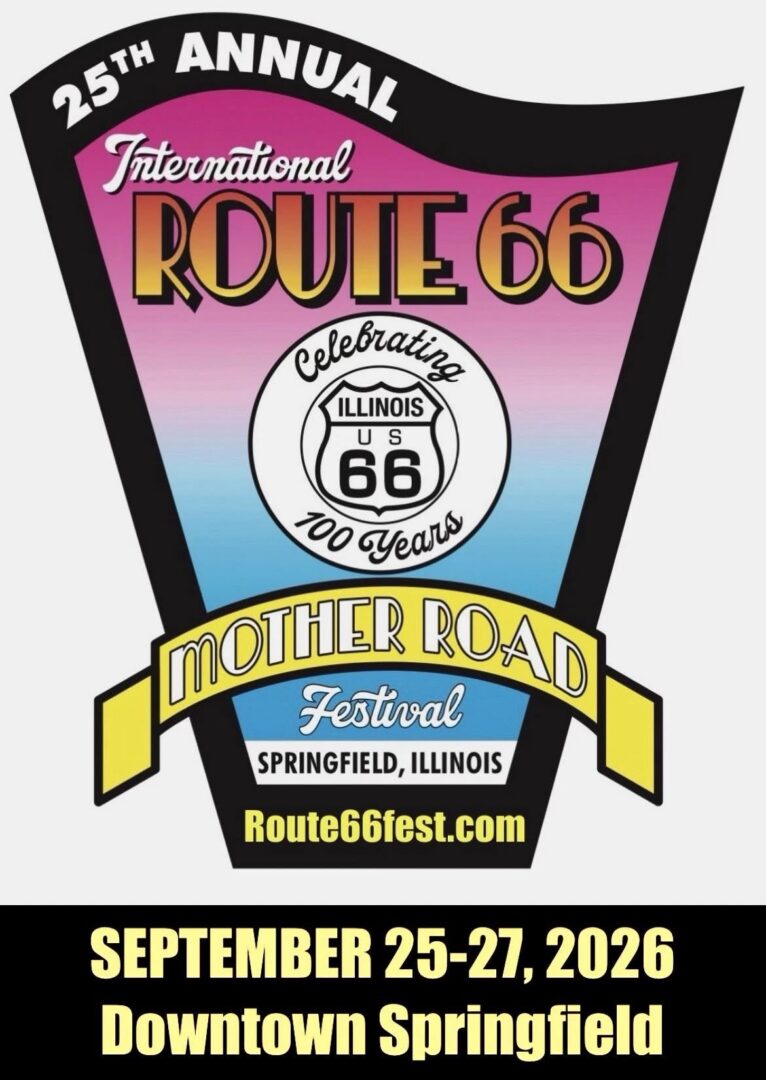 This weekend, Springfield, Illinois is hosting the 25th Annual International Route 66 Mother Road Festival from September 25-27! This year, the festival celebrates 100 years of Route 66.
Route 66 was first constructed in 1926 but was far from complete and only had around 800 miles of paved road. The road was finished and completely paved in 1938, and it now stretches from Chicago all the way to Los Angeles. It passes through eight states and is one of the Unites States’ first continuous highways.
The event is an annual classic-car show held in downtown Springfield, featuring cars, music and fun for all ages! Several retro and custom cars will be available for viewing, many led by Dave Kindig and Dennis Gage, two designers known for their custom and classic car builds.
- Details
 Gene Deitch was born in Chicago, Illinois on Aug. 8, 1924, later moving to California with his family and attending school in Hollywood. Deitch’s passion for the arts and drawing was apparent as a kid, making his first animated cartoon when he was only 13 years old. However, after graduating high school, the United States was in the midst of World War II, and Deitch ended up working for North American Aviation. He used his artistic talent to draw industrial parts and catalogs in aircraft factories. He was eventually drafted and served for about a year before he contracted pneumonia and was honorably discharged. This moment allowed Deitch to pursue his artistic career, which originally consisted of mostly music and sound engineering.
- Details

This past week, Mattoon celebrated 41 years of Bagelfest! This community staple features days of fun and entertainment for the whole family. The festival celebrates the town’s claim of the largest bagel factory in the world. The event features days of events, live shows and, of course, many bagels.
More Articles …


I LIKE ILLINOIS © Copyright 2025